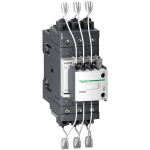
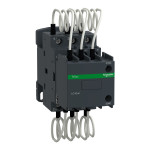
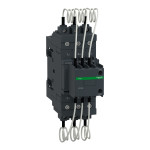
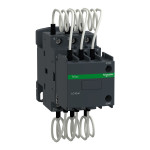
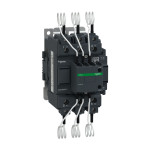
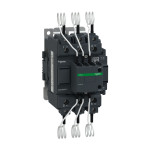
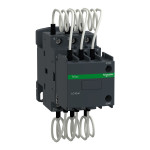
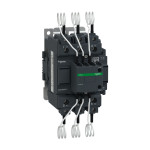
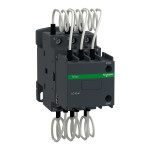
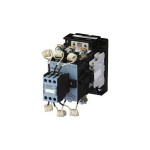
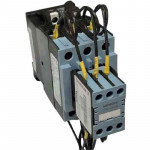
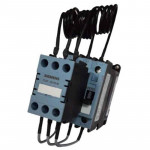
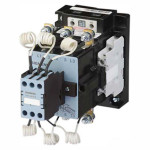
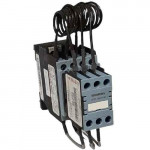
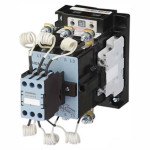
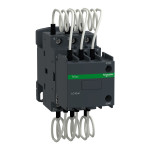
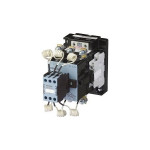
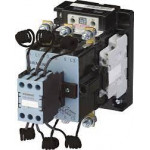
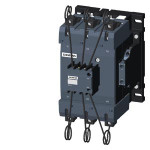
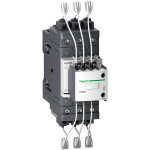
Buy Capacitor Duty Contactors Online at Electrihub
A capacitor duty contactor is a specially designed switching device used exclusively for connecting and disconnecting power factor correction (PFC) capacitor banks in electrical power systems. Unlike standard power contactors, capacitor duty contactors are engineered to withstand the extreme inrush currents and transient overvoltages that occur every time a capacitor bank is switched — conditions that would rapidly destroy a conventional contactor not designed for this purpose.
When a capacitor bank is energised, it draws an inrush current that can be 20 to 100 times the rated current for a fraction of a millisecond. This inrush current causes severe contact welding, contact erosion, and coil damage in standard contactors. Capacitor duty contactors overcome this through built-in pre-insertion resistors or reactor-damping networks, silver alloy contacts rated for high-cycle switching, and reinforced coil systems designed for rapid make-and-break duty.
Capacitor duty contactors are rated under AC-6b duty as defined in IEC 60947-4-1, which is the specific duty category for switching capacitor banks. They are a mandatory requirement in all automatic power factor correction (APFC) panels, fixed capacitor bank installations, and harmonic filter banks used in industrial and commercial power distribution systems.
At Electrihub we stock capacitor duty contactors from globally certified manufacturers — Schneider Electric, ABB, Siemens, Eaton, Lauritz Knudsen (L&T), Havells, HPL, and C&S Electric — covering capacitor ratings from 5 kVAr to 100 kVAr per step and beyond, for 415 V and 440 V three-phase power factor correction systems.
Why Standard Power Contactors Cannot Switch Capacitor Banks
This is one of the most critical points in power factor correction system design. Using a standard AC-3 rated power contactor to switch a capacitor bank will cause rapid and permanent contactor failure, typically within days or weeks of commissioning. The reasons are:
Extreme inrush current: When a discharged capacitor bank is connected to the supply, it initially behaves like a short circuit — drawing inrush currents of 20–100× the rated current for 1–5 milliseconds. Standard contactor contacts are not designed to withstand this repetitive high-current making duty and will weld together or erode rapidly.
Transient overvoltages: Capacitor switching generates voltage transients (switching surges) that can reach 2–3× the normal supply voltage. These transients stress the contactor coil insulation, contact gaps, and connected equipment.
High switching frequency: In APFC systems, capacitor banks may be switched on and off hundreds of times per day as the load power factor varies. Standard contactors are rated for far fewer operations under load conditions — capacitor duty contactors are specifically rated for this high-cycle AC-6b duty with silver alloy contacts and extended electrical endurance.
Pre-insertion resistors: Capacitor duty contactors incorporate pre-insertion damping resistors or reactors in the contact circuit that limit the inrush current during the make operation, then short-circuit these resistors after the capacitor is fully charged. This two-stage closing action protects both the contactor and the capacitor bank from damaging inrush transients.
How a Capacitor Duty Contactor Works
A capacitor duty contactor operates in two stages during the make (closing) sequence:
Stage 1 — Pre-insertion: As the main contacts begin to close, the pre-insertion resistors (or reactors) are inserted in series with the capacitor bank. These resistors limit the inrush current to a safe level — typically 5–10× rated current rather than 50–100× — for the first few milliseconds of energisation, allowing the capacitor voltage to rise smoothly.
Stage 2 — Full connection: Once the capacitor voltage has stabilised (within approximately 5–20 ms), the pre-insertion components are shorted out by the main contacts completing their travel, and the capacitor bank is now fully connected to the supply at steady-state current. The break (opening) sequence is a single-stage operation at rated current, which is well within the contact rating.
This two-stage closing action is what distinguishes a capacitor duty contactor from a standard contactor and is the reason it must be used — and never substituted with — a standard power contactor in any capacitor bank switching application.
Where Are Capacitor Duty Contactors Used?
Automatic Power Factor Correction (APFC) Panels — The primary application. APFC panels use multiple capacitor banks switched in and out automatically by an APFC relay as load conditions change. Each capacitor step requires a dedicated capacitor duty contactor rated for the kVAr of that step. APFC panels are mandatory in large industrial and commercial installations to avoid power factor penalty charges from electricity utilities.
Fixed Capacitor Banks — Where the power factor correction is fixed (not automatically varied), a single capacitor duty contactor switches the entire bank on and off manually or by timer. Common in factories, pumping stations, and commercial buildings with relatively constant loads.
Harmonic Filter Banks — Detuned filter reactors combined with capacitors are used to provide power factor correction while also attenuating harmonic currents. The capacitor duty contactor switches the combined reactor-capacitor filter unit, which has even more severe inrush characteristics than a plain capacitor bank.
Medium Voltage Capacitor Banks (via Step-Down) — In medium voltage systems, capacitor duty contactors at the LV level switch capacitor banks connected via step-down transformers for MV power factor correction in industrial substations.
Renewable Energy and Solar Installations — Solar PV and wind energy installations use capacitor banks for reactive power compensation at the point of common coupling (PCC). Capacitor duty contactors switch these compensation banks in response to grid reactive power demands.
Capacitor Duty Contactor Brands and Series – Technical Comparison
The table below covers every capacitor duty contactor brand and series stocked by Electrihub. Use the kVAr rating, coil voltage, and auxiliary contact columns to shortlist the right product for your APFC panel or capacitor bank installation, then click the series link to browse available stock.
| Brand |
Series / Model |
Capacitor Rating (kVAr) |
AC-6b Rated Current |
System Voltage |
Coil Voltage |
Inbuilt Aux. Contacts |
Standard |
Browse |
| Schneider Electric |
LC1DGK (TeSys D Capacitor) |
5 – 12.5 kVAr |
Up to 25 A (AC-6b) |
415 V / 440 V AC |
24 V DC, 110 V AC, 230 V AC, 415 V AC |
1NO + 1NC |
IEC 60947-4-1 (AC-6b) |
View Products |
| Schneider Electric |
LC1DWK (TeSys D Capacitor) |
15 – 25 kVAr |
Up to 50 A (AC-6b) |
415 V / 440 V AC |
24 V DC, 110 V AC, 230 V AC, 415 V AC |
1NO + 1NC |
IEC 60947-4-1 (AC-6b) |
View Products |
| Schneider Electric |
LC1DFK / LC1DPK (TeSys D Capacitor) |
30 – 60 kVAr |
Up to 105 A (AC-6b) |
415 V / 440 V AC |
24 V DC, 110 V AC, 230 V AC, 415 V AC |
1NO + 1NC |
IEC 60947-4-1 (AC-6b) |
View Products |
| ABB |
UA Series (UA16 – UA110) |
5 – 75 kVAr |
16 A – 110 A (AC-6b) |
415 V / 440 V AC |
24 V DC, 48 V AC, 110 V AC, 230 V AC, 415 V AC |
1NO + 1NC |
IEC 60947-4-1 (AC-6b) |
View Products |
| ABB |
UA300 (Heavy Duty) |
100 kVAr and above |
300 A (AC-6b) |
415 V / 440 V AC |
110 V AC, 230 V AC, 415 V AC |
1NO + 1NC |
IEC 60947-4-1 (AC-6b) |
View Products |
| Siemens |
3RT2 Capacitor Duty (3RT26) |
5 – 30 kVAr |
Up to 60 A (AC-6b) |
415 V / 440 V AC |
24 V DC, 24 V AC, 110 V AC, 230 V AC, 400 V AC |
1NO + 1NC |
IEC 60947-4-1 (AC-6b) |
View Products |
| Siemens |
3RT2 Capacitor Duty (3RT28) |
30 – 75 kVAr |
Up to 145 A (AC-6b) |
415 V / 440 V AC |
24 V DC, 110 V AC, 230 V AC, 400 V AC |
1NO + 1NC |
IEC 60947-4-1 (AC-6b) |
View Products |
| Eaton (Moeller) |
DILK Series (DILK12 – DILK72) |
5 – 50 kVAr |
12 A – 72 A (AC-6b) |
415 V / 440 V AC |
24 V DC, 24 V AC, 48 V AC, 110 V AC, 230 V AC, 400 V AC |
1NO + 1NC |
IEC 60947-4-1 (AC-6b) |
View Products |
| Lauritz Knudsen |
MVO / MCX Capacitor Series |
5 – 50 kVAr |
Up to 105 A (AC-6b) |
415 V AC |
24 V DC, 110 V AC, 220 V AC, 415 V AC |
1NO + 1NC |
IEC / IS 60947-4-1 (AC-6b) |
View Products |
| Havells |
Capacitor Duty Series |
5 – 40 kVAr |
Up to 80 A (AC-6b) |
415 V AC |
24 V DC, 110 V AC, 220 V AC, 415 V AC |
1NO + 1NC |
IEC / IS 60947-4-1 (AC-6b) |
View Products |
| HPL Electric |
AFC Capacitor Duty Series |
5 – 30 kVAr |
Up to 60 A (AC-6b) |
415 V AC |
24 V DC, 110 V AC, 220 V AC, 415 V AC |
1NO + 1NC |
IEC / IS 60947-4-1 (AC-6b) |
View Products |
| C&S Electric |
IC Capacitor Duty Series |
5 – 50 kVAr |
Up to 105 A (AC-6b) |
415 V AC |
24 V DC, 110 V AC, 220 V AC, 415 V AC |
1NO + 1NC |
IEC / IS 60947-4-1 (AC-6b) |
View Products |
All capacitor duty contactors are rated to IEC 60947-4-1 AC-6b duty. kVAr ratings listed are at 415 V AC, 50 Hz, three-phase. Refer to individual product datasheets for derating at 440 V and for detuned reactor installations. Always verify suitability with the APFC relay manufacturer's recommendations.
About the Brands We Stock
Schneider Electric — LC1DGK, LC1DWK, LC1DFK, LC1DPK
Schneider Electric's capacitor duty contactor range is built on the TeSys D platform, offering seamless integration with their APFC relay and capacitor panel systems. The LC1DGK and LC1DWK series cover small to medium APFC steps from 5 kVAr to 25 kVAr at 415 V, while the LC1DFK and LC1DPK extend coverage to 60 kVAr for larger industrial APFC panels. All models incorporate built-in pre-insertion damping resistors, reinforced silver alloy contacts rated for AC-6b high-cycle duty, and are directly compatible with Schneider's APFC relays and TeSys D auxiliary blocks. Wide coil voltage range from 24 V DC to 415 V AC is available across the series.
Browse All Schneider Capacitor Duty Contactors →
ABB — UA Series (UA16 to UA300)
ABB's UA series is one of the most widely recognised capacitor duty contactors globally. The range covers capacitor banks from 5 kVAr (UA16) all the way up to 100 kVAr and beyond (UA300), making it suitable for both small commercial APFC panels and large industrial power factor correction systems. ABB UA contactors feature integrated damping resistors, silver alloy contacts with high electrical endurance, and a compact modular design that fits standard APFC panel layouts. They are compatible with ABB's RVC and PFC APFC relays and support the full range of ABB auxiliary blocks for feedback and interlocking circuits. Available in coil voltages from 24 V DC to 415 V AC.
Browse All ABB Capacitor Duty Contactors →
Siemens — 3RT26, 3RT28 (SIRIUS Capacitor Duty)
Siemens' capacitor duty contactors are part of the SIRIUS 3RT2 platform, ensuring direct physical and electrical compatibility with the broader Siemens switchgear ecosystem. The 3RT26 series covers small and medium APFC steps (5–30 kVAr at 415 V), while the 3RT28 series handles larger capacitor bank steps up to 75 kVAr. Siemens capacitor contactors incorporate peak-voltage-optimised closing technology that times the contact closure to a favourable point in the AC voltage cycle, minimising inrush current without mechanical pre-insertion resistors in some models — reducing maintenance requirements. Side-mount 3RH2911 auxiliary blocks and 3RT1916 front-mount blocks are directly compatible.
Browse All Siemens Capacitor Duty Contactors →
Eaton (Moeller) — DILK Series
Eaton's DILK series is a dedicated capacitor duty contactor range built on the DILM platform, covering 5 kVAr to 50 kVAr at 415 V in sizes DILK12 through DILK72. DILK contactors feature integrated series resistors with bypass contacts for inrush current limitation, silver alloy contacts rated for millions of AC-6b switching operations, and the same modular accessories platform as the DILM power contactor range — including DILM-XHI auxiliary blocks for additional control contacts. Available in coil voltages from 24 V DC to 400 V AC, the DILK series is widely used in European and Indian industrial APFC systems.
Browse All Eaton Capacitor Duty Contactors →
Lauritz Knudsen — MVO, MCX Capacitor Series
Lauritz Knudsen (formerly L&T Electrical & Automation) offers capacitor duty contactors certified to IS/IEC 60947-4-1 (AC-6b), manufactured in India and widely used in Indian APFC panels, industrial power factor correction systems, and government electrical projects. The MVO and MCX capacitor series cover 5 kVAr to 50 kVAr at 415 V with built-in inrush current limiting circuitry. ISI marked and BIS compliant, Lauritz Knudsen capacitor contactors are compatible with their MNX and ExceeD contactor platform accessories and are accepted in CPWD and government tender specifications.
Browse All Lauritz Knudsen Capacitor Duty Contactors →
Havells — Capacitor Duty Series
Havells offers ISI-marked capacitor duty contactors to IEC/IS 60947-4-1 (AC-6b) for the Indian market, covering 5 kVAr to 40 kVAr at 415 V. With built-in damping resistors and silver alloy contacts, Havells capacitor contactors are suitable for small to medium industrial and commercial APFC panels. Their wide availability through the Havells distribution network across India makes them a practical choice for APFC panel builders requiring fast local procurement and reliable after-sales support.
Browse All Havells Capacitor Duty Contactors →
HPL Electric — AFC Capacitor Duty Series
HPL Electric provides IEC-rated capacitor duty contactors for small to medium APFC applications, covering 5 kVAr to 30 kVAr at 415 V. A competitively priced option for Indian panel builders and system integrators constructing cost-sensitive APFC panels for commercial and light-industrial power factor correction, HPL capacitor contactors are rated AC-6b and incorporate the necessary inrush current limiting design for reliable long-term capacitor bank switching.
Browse All HPL Capacitor Duty Contactors →
C&S Electric — IC Capacitor Duty Series
C&S Electric manufactures capacitor duty contactors to IEC/IS 60947-4-1 (AC-6b), covering 5 kVAr to 50 kVAr at 415 V. Compatible with the IC series power contactor accessories platform, C&S capacitor contactors are widely specified in Indian government APFC projects, state electricity board installations, and large industrial power factor correction systems where ISI-certified, locally manufactured products are a requirement.
Browse All C&S Capacitor Duty Contactors →
How to Select the Right Capacitor Duty Contactor
Step 1 — Determine the kVAr rating of each capacitor step
In an APFC panel, the total capacitor bank is divided into multiple steps of equal or different kVAr ratings. Each step requires one capacitor duty contactor. Identify the kVAr value of each individual step — for example, a 150 kVAr APFC panel may use six 25 kVAr steps, each requiring a contactor rated for at least 25 kVAr at 415 V AC.
Step 2 — Convert kVAr to AC-6b rated current
The AC-6b rated current can be calculated from the capacitor kVAr and system voltage. For a three-phase system at 415 V: I (A) = kVAr × 1000 ÷ (√3 × 415). Select a contactor whose AC-6b rated current exceeds this calculated value. Always apply a minimum 20–25% safety margin over the calculated current to account for voltage variations and harmonic content.
Step 3 — Check for detuned reactor installations
If your APFC system uses detuned filter reactors in series with the capacitors (common where harmonics are present), the fundamental frequency current through the capacitor is higher than for a plain capacitor of the same kVAr. A detuning factor of 7% (p = 0.07) increases the current by approximately 7–8%. Always use a de-rated contactor or upsize to the next current rating when detuned reactors are fitted.
Step 4 — Select coil voltage
The APFC relay output drives the capacitor contactor coil directly. Most APFC relays provide relay output contacts suitable for 230 V AC coils — the most common coil voltage for APFC applications in India. Verify the APFC relay output rating and select the corresponding capacitor contactor coil voltage. For PLC-driven APFC systems, 24 V DC coil contactors are used with interposing relays or solid-state outputs.
Step 5 — Never substitute a standard power contactor
This cannot be overstated: never use a standard AC-3 rated power contactor to switch a capacitor bank, even temporarily. The inrush current at capacitor energisation will weld or severely damage the contacts within days, causing panel failure and potential fire risk. Always specify and install a capacitor duty contactor (AC-6b rated) for every capacitor bank step.
Key Technical Terms
AC-6b Duty
The IEC 60947-4-1 duty category for switching shunt capacitor banks. AC-6b ratings define the contactor's ability to make and break the specific high-inrush, transient-overvoltage conditions produced by capacitor bank switching. A contactor must be specifically rated AC-6b for capacitor duty — the AC-3 motor rating cannot be used for this purpose.
Power Factor Correction (PFC)
Power factor is the ratio of active power (kW) to apparent power (kVA). A low power factor means higher apparent current for the same useful power, causing increased cable losses, larger transformer ratings, and power factor penalty charges from the electricity utility. Capacitor banks correct power factor by supplying reactive power locally, reducing the reactive current drawn from the supply.
APFC (Automatic Power Factor Correction)
An APFC panel uses an APFC relay to continuously monitor the load power factor and automatically switch capacitor bank steps in and out to maintain the target power factor (typically 0.95 or above). Each step is switched by a dedicated capacitor duty contactor under the control of the APFC relay's output.
Pre-insertion Resistor / Damping Network
The built-in component in a capacitor duty contactor that limits the inrush current during the make (closing) operation. It is inserted in series with the capacitor for the first few milliseconds of energisation, then shorted out as the main contacts complete their travel. This two-stage closing action is the fundamental design feature that makes capacitor duty contactors different from standard contactors.
Detuned Filter Reactor
A reactor (inductor) connected in series with a capacitor bank to create a detuned filter that provides power factor correction while also suppressing harmonic currents. The detuning prevents the capacitor bank from resonating with the supply system at harmonic frequencies. Detuned reactors increase the fundamental current through the capacitor contactor and must be accounted for when selecting the contactor rating.
kVAr (Kilovolt-Ampere Reactive)
The unit of reactive power provided by a capacitor bank. In power factor correction, capacitor banks are specified in kVAr — for example, a 25 kVAr capacitor step provides 25 kVAr of reactive power compensation at the rated voltage. The kVAr rating of a capacitor bank directly determines the required capacitor duty contactor rating.
Frequently Asked Questions — Capacitor Duty Contactors
Can I use a standard power contactor instead of a capacitor duty contactor?
No — never. A standard AC-3 rated power contactor will fail rapidly when used to switch a capacitor bank. The inrush current during capacitor energisation (20–100× rated current) will weld the contacts shut or erode them within days, causing contactor failure, capacitor bank damage, and potential fire hazard. Always use a capacitor duty contactor (AC-6b rated) with built-in inrush limiting for every capacitor bank switching application.
What does AC-6b mean on a capacitor duty contactor?
AC-6b is the IEC 60947-4-1 duty category specifically defined for switching shunt capacitor banks. It defines the making and breaking capacity of the contactor under the high-inrush, transient-overvoltage conditions specific to capacitor switching. A contactor carrying an AC-6b rating has been tested and certified for this demanding duty — contactors with only AC-3 ratings have not.
How do I calculate the right capacitor duty contactor size for my APFC panel?
Calculate the AC-6b rated current using: I (A) = kVAr × 1000 ÷ (√3 × 415) for a 415 V three-phase system. Then add a 20–25% safety margin. Example: For a 25 kVAr step at 415 V — I = 25,000 ÷ (1.732 × 415) = 34.8 A. With 25% margin = 43.5 A → Select a contactor rated at least 50 A AC-6b. If detuned reactors are used, upsize further by 7–10%.
What is the difference between a fixed capacitor bank and an APFC panel?
A fixed capacitor bank has a fixed kVAr value permanently connected (or manually switched) and provides constant reactive power compensation — suitable for loads with a relatively constant power factor. An APFC panel uses multiple capacitor steps switched automatically by an APFC relay to match the varying reactive power demand of changing loads — providing accurate dynamic power factor correction and avoiding over-compensation.
Do I need a separate capacitor duty contactor if detuned reactors are installed?
Yes — and you need to upsize the contactor. When detuned reactors (e.g. 7% or 14% detuning) are used in series with the capacitors, the fundamental frequency current through the contactor is higher than for a plain capacitor of the same kVAr. A 7% detuned reactor increases capacitor current by approximately 7–8%. Always check the reactor manufacturer's documentation for the exact derating factor and select a capacitor duty contactor accordingly.
How many switching operations should a capacitor duty contactor withstand?
Quality capacitor duty contactors from major brands (Schneider, ABB, Siemens, Eaton) are rated for 1–3 million AC-6b switching operations. In a busy APFC system switching 50–100 times per day, this equates to 27–55 years of service life — making the contactor effectively maintenance-free for the life of the APFC panel if correctly sized.
Are all capacitor duty contactors on Electrihub original and genuine?
Yes. Electrihub sources all products exclusively through authorised distribution channels. All capacitor duty contactors are supplied in original manufacturer packaging with full traceability. Manufacturer certificates of conformity and test certificates are available on request for project and tender documentation.
Popular Brands of Capacitor duty contactor
ABB Capacitor duty contactor
Eaton Capacitor duty contactor
Epcos-TDK Capacitor duty contactor
HPL Capacitor duty contactor
Lauritz knudsen Capacitor duty contactor
Siemens Capacitor duty contactor
Schneider Capacitor duty contactor
Categories in Contactors and Contactor Relays
Auxiliary Contactors |
Capacitor duty contactor |
Motor Protection Relay |
Motor Starter |
MPCB |
MPCB Accessories |
Over Load Relay |
Overload Relays Accessories |
Power Contactor |
Power Contactor Accessories |
Protective Relays |
Protective Relays Accessories