

 United States
($USD)


 Product Range
 Connectors
 Electrical Conduits and Fittings
 EV Chargers
 Home Automation
 Mixed Products
 Power Supplies and Tools
 Rack Power Distribution
 Low Voltage Breakers
 Contactors and Contactor Relays
 Home Distribution Products
 Power Monitoring & PF Correction
 Changeover Switches & Isolators
 Industrial Automation Products
 Signalling and Controlling
 Medium Voltage Products
 Wires & Cables
 Industrial Motors
 Pumps
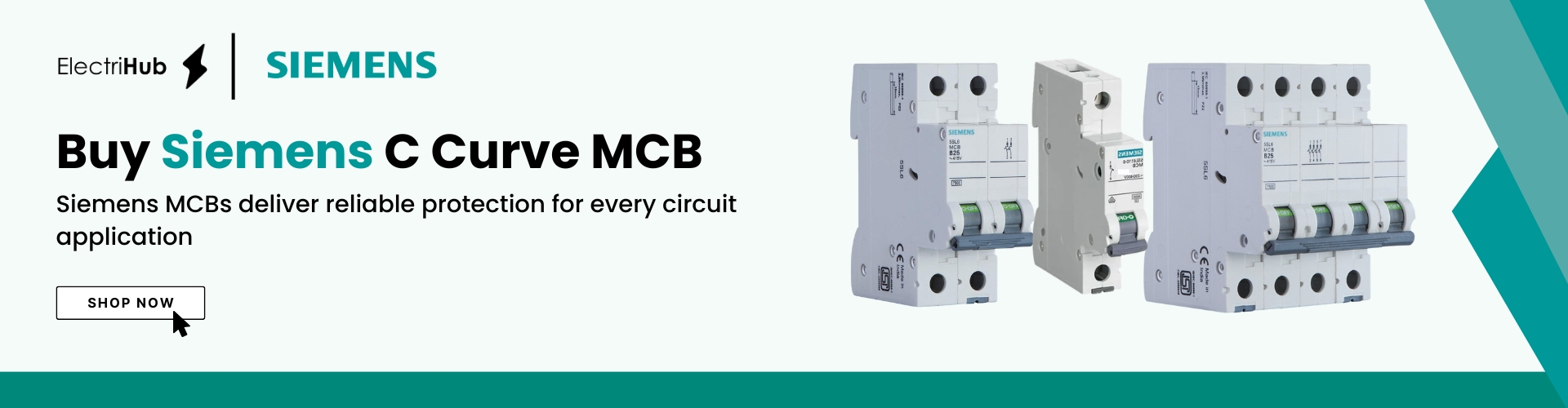
Buy Siemens C Curve MCB Online – Complete Siemens C Curve MCB Range
✓ Full Siemens C Curve MCB Range
SENTRON 5SL (6kA), 5SY (10kA) & 5SP (25kA) — plus Betagard (BIS) — in 1P, 2P, 3P & 4P from 6A to 63A, all with C Curve (-8 suffix) trip characteristic
✓ 100% Genuine Siemens Products
Authentic Siemens SENTRON and Betagard C Curve MCBs with IEC 60898-1 / IEC 60947-2 and BIS ISI certification — full manufacturer warranty on every product
✓ Worldwide Shipping
Fast global delivery with complete export documentation — stocked across all C Curve ratings and pole configurations for residential, commercial, and industrial projects
✓ Technical Support
Expert guidance on C Curve vs B Curve vs D Curve selection, series and breaking capacity choice, current rating sizing, and pole configuration for your specific circuit
Shop Siemens C Curve MCB by Series and Poles

Siemens 5SL42407RC C Curve MCB
View Products
Siemens 5SL41107RC C Curve MCB
View Products
Siemens 5SL41067RC C Curve MCB – 25kA SENTRON
View ProductsSiemens C Curve MCB – Complete Range Specifications
| Series | Poles | C Curve Ratings Available | Breaking Capacity (Icu) | Voltage Rating | Standard | Part No. Format (C Curve) |
|---|---|---|---|---|---|---|
| 5SL4 (SENTRON) | 1P | 6A, 10A, 13A, 16A, 20A, 25A, 32A, 40A, 50A, 63A | 6kA @ 230/400V AC | 230/400V AC | IEC 60898-1 / IEC 60947-2 | 5SL41[xx]-8 |
| 5SL6 (SENTRON) | 2P / 3P / 4P | 6A, 10A, 13A, 16A, 20A, 25A, 32A, 40A, 50A, 63A | 6kA @ 230/400V AC | 230/400V AC | IEC 60898-1 / IEC 60947-2 | 5SL6[P][xx]-8 |
| 5SY4 (SENTRON) | 1P | 6A, 10A, 13A, 16A, 20A, 25A, 32A, 40A, 50A, 63A | 10kA @ 230/400V AC | 230/400V AC | IEC 60947-2 | 5SY41[xx]-8 |
| 5SY6 (SENTRON) | 2P / 3P / 4P | 6A, 10A, 13A, 16A, 20A, 25A, 32A, 40A, 50A, 63A | 10kA @ 230/400V AC | 230/400V AC | IEC 60947-2 | 5SY6[P][xx]-8 |
| 5SP4 (SENTRON) | 1P | 6A, 10A, 13A, 16A, 20A, 25A, 32A, 40A, 50A, 63A | 25kA @ 230/400V AC | 230/400V AC | IEC 60947-2 | 5SP41[xx]-8 |
| 5SP6 (SENTRON) | 2P / 3P / 4P | 6A, 10A, 13A, 16A, 20A, 25A, 32A, 40A, 50A, 63A | 25kA @ 230/400V AC | 230/400V AC | IEC 60947-2 | 5SP6[P][xx]-8 |
| Betagard 6kA (5SM3) | 1P / 2P / 3P / 4P | 6A, 10A, 16A, 20A, 25A, 32A, 40A, 63A | 6kA @ 230/415V AC | 230/415V AC | IS/IEC 60898-1 (BIS ISI) | 5SM3 [P][xx]-8 |
| Betagard 10kA (5SM6) | 1P / 2P / 3P / 4P | 6A, 10A, 16A, 20A, 25A, 32A, 40A, 63A | 10kA @ 230/415V AC | 230/415V AC | IS/IEC 60898-1 (BIS ISI) | 5SM6 [P][xx]-8 |
* [P] = Poles digit (1, 2, 3, or 4) | [xx] = Current rating digits (06=6A, 10=10A, 16=16A, 20=20A, 25=25A, 32=32A, 40=40A, 50=50A, 63=63A) | Suffix -8 always denotes C Curve across all Siemens SENTRON and Betagard MCB series.
Siemens C Curve MCB – Circuit Application & Current Rating Selection Guide
| Circuit Type / Application | Recommended C Curve Rating | Poles | Recommended Series | Typical Part Number |
|---|---|---|---|---|
| Residential Lighting Circuit (LED/CFL) | 6A C Curve | 1P | 5SL4 (6kA) / Betagard 6kA | 5SL4106-8 / 5SM3 116-8 |
| Residential Socket Group Circuit | 16A C Curve | 1P | 5SL4 (6kA) / Betagard 6kA | 5SL4116-8 / 5SM3 116-8 |
| Dedicated 1-Ton Split AC Circuit | 20A C Curve | 1P | 5SL4 (6kA) / Betagard 6kA | 5SL4120-8 / 5SM3 120-8 |
| Dedicated 1.5-Ton Split AC Circuit | 25A C Curve | 1P | 5SL4 (6kA) / Betagard 6kA | 5SL4125-8 / 5SM3 125-8 |
| Dedicated 2-Ton AC / EV Charger (7kW) | 32A C Curve | 1P | 5SL4 (6kA) / Betagard 6kA | 5SL4132-8 / 5SM3 132-8 |
| Electric Shower (8.5kW–9.5kW) | 40A C Curve | 1P or 2P | 5SL4 / 5SL6 (6kA) | 5SL4140-8 / 5SL6240-8 |
| Residential Flat Incomer (up to 8kW) | 40A C Curve | 2P | 5SL6 (6kA) / Betagard 6kA | 5SL6240-8 / 5SM3 240-8 |
| Residential Flat Incomer (above 8kW) | 63A C Curve | 2P | 5SL6 (6kA) / Betagard 6kA | 5SL6263-8 / 5SM3 263-8 |
| Commercial Lighting Circuit | 10A–16A C Curve | 1P | 5SY4 (10kA) | 5SY4110-8 / 5SY4116-8 |
| Commercial Socket / Small Power Circuit | 16A–20A C Curve | 1P | 5SY4 (10kA) | 5SY4116-8 / 5SY4120-8 |
| Commercial Sub-Main Incomer (Single-Phase) | 40A–63A C Curve | 2P | 5SY6 (10kA) | 5SY6240-8 / 5SY6263-8 |
| Three-Phase HVAC Equipment Supply | 32A–63A C Curve | 3P | 5SY6 (10kA) | 5SY6332-8 / 5SY6363-8 |
| Three-Phase Distribution Board Incomer (TN-C-S) | 40A–63A C Curve | 3P | 5SL6 / 5SY6 (6kA or 10kA) | 5SL6340-8 / 5SY6363-8 |
| ATS / Generator Changeover Panel Incomer (TN-S) | 40A–63A C Curve | 4P | 5SY6 (10kA) | 5SY6440-8 / 5SY6463-8 |
| Industrial Distribution Board Incomer | 40A–63A C Curve | 3P or 4P | 5SP6 (25kA) | 5SP4340-8 / 5SP4463-8 |
| Data Centre PDU Outgoing Circuit | 16A–32A C Curve | 1P | 5SP4 (25kA) | 5SP4116-8 / 5SP4132-8 |
| Inverter-Driven Equipment Supply (VFD/Drive) | 16A–63A C Curve | 1P or 3P | 5SY4 / 5SY6 (10kA) | 5SY4132-8 / 5SY6363-8 |
| BMS Controls / UPS Supply / PLC Panel | 6A–16A C Curve | 1P | 5SY4 (10kA) | 5SY4106-8 / 5SY4116-8 |
Contact Our Technical Team
Not sure whether a Siemens 5SL C Curve MCB or a Siemens 5SY C Curve MCB is correct for your distribution board? Need to confirm whether C Curve is the right trip characteristic for your specific circuit — or whether B Curve or D Curve would be more appropriate? Our engineers will help you select the correct Siemens C Curve MCB series, breaking capacity, current rating, and pole configuration — matched to your load schedule, fault current analysis, earthing system, and applicable electrical standard.
Contact NowDownload Product Line Card
Browse our complete range of Siemens SENTRON MCBs and Siemens Betagard MCBs — all series, all curves (B, C, D), all pole configurations (1P, 2P, 3P, 4P), and all current ratings from 6A to 63A — alongside Siemens RCCBs, RCBOs, MCCBs (3VA series), contactors, and switchgear accessories for global projects.
Download Line CardCompany Profile
Learn more about ElectriHub — your trusted global partner for genuine Siemens circuit protection and switchgear products, delivered with technical excellence and after-sales support worldwide.
Download ProfileWhat is a Siemens C Curve MCB?
A Siemens C Curve MCB is a Miniature Circuit Breaker with a C-type trip characteristic — meaning its instantaneous (magnetic) tripping threshold is set at 5 to 10 times the rated current (5–10× In). This trip characteristic is what distinguishes a C Curve MCB from a B Curve (3–5× In) or D Curve (10–20× In) MCB — the C Curve sits in the middle, providing a deliberate tolerance for the brief start-up inrush currents generated by air conditioners, inverter drives, refrigerators, fluorescent and LED ballast lighting, switch-mode power supplies, and other loads with moderate inrush, while still tripping reliably and rapidly on genuine sustained overloads and short-circuit faults.
The C Curve MCB Siemens range spans the full Siemens SENTRON product family — the 5SL series (6kA, IEC 60898-1/IEC 60947-2), the 5SY series (10kA, IEC 60947-2), and the 5SP series (25kA, IEC 60947-2) — plus the Siemens Betagard India range (6kA and 10kA, IS/IEC 60898-1 with BIS ISI certification), covering 1-pole through 4-pole configurations and current ratings from 6A to 63A. Across all Siemens MCB series, the C Curve is consistently identified by the suffix -8 in the part number — a universal Siemens designation that remains constant across all series, pole counts, and current ratings. When you buy C Curve Siemens MCB from ElectriHub, you receive 100% genuine Siemens products with full IEC or BIS certification and manufacturer warranty.
The C Curve Trip Characteristic — Technical Explanation
Every MCB has two separate protective mechanisms that work in parallel — the thermal (bimetallic) overload trip and the instantaneous (magnetic) short-circuit trip. The C Curve designation refers exclusively to the instantaneous magnetic trip threshold:
- Thermal overload trip (both B, C, and D Curve identical): All Siemens MCBs — regardless of curve type — use the same thermal bimetallic overload mechanism that trips the MCB within a time inversely proportional to the overload current. A 20% overload (1.2× In) will trip the MCB within approximately one hour; a 45% overload (1.45× In) will trip within one to two minutes; a 100% overload (2× In) will trip within tens of seconds. The thermal mechanism responds slowly to sustained overloads and does not differentiate between B, C, and D Curve MCBs — the curve designation only affects the instantaneous trip
- Instantaneous magnetic trip — C Curve (5–10× In): The C Curve magnetic trip operates instantaneously (within milliseconds) when the fault current exceeds 5× In and is guaranteed to operate before 10× In. For a Siemens C Curve 16A MCB, this means instantaneous trip at 80A to 160A fault current. For a Siemens C Curve 32A MCB, instantaneous trip at 160A to 320A. For a Siemens C Curve 63A MCB, instantaneous trip at 315A to 630A. The C Curve magnetic trip threshold is deliberately set higher than the B Curve to allow the MCB to ride through the brief start-up inrush of connected equipment — typically lasting less than 100ms — without tripping, while still providing fast protection against genuine short-circuit faults that sustain high fault currents beyond the inrush transient period
- Why C Curve for most circuits: The majority of electrical loads in modern residential and commercial installations — split air conditioners with inverter drives, variable frequency drives, switch-mode power supplies, LED drivers, refrigerator compressors, washing machine motors — generate start-up inrush currents in the range of 3–8× In for periods of 10–100ms. A B Curve MCB (3–5× In instantaneous trip) may nuisance-trip on these inrush currents, particularly for larger AC units and motor-driven appliances. The C Curve's 5–10× In instantaneous threshold provides sufficient margin above typical equipment inrush to prevent nuisance tripping while remaining well below the short-circuit fault current levels that the MCB must interrupt to protect the cable and distribution system
Siemens C Curve MCB — Key Applications in Residential Wiring
The Siemens C Curve MCB is the dominant trip characteristic in Indian and IEC residential distribution — it is the default specification for the vast majority of outgoing circuits in residential flat and villa distribution boards:
- Dedicated Split Air Conditioner Circuits (C Curve, 20A–32A, 1P): The most critical and highest-volume C Curve MCB application in Indian residential wiring — every split AC unit in a residential flat requires its own dedicated C Curve MCB. A 1-ton inverter split AC (approximately 5–8A running current, 25–40A start-up inrush through the inverter drive) requires a Siemens C Curve 20A 1P MCB; a 1.5-ton requires a 25A C Curve; a 2-ton requires a 32A C Curve. The C Curve is specifically chosen for AC circuits because the inverter drive generates a brief but significant inrush current transient on compressor start that would nuisance-trip a B Curve MCB but is comfortably within the C Curve 5–10× In instantaneous trip threshold
- General Socket and Appliance Circuits (C Curve, 16A–20A, 1P): Socket outlet group circuits for bedroom, living room, and kitchen socket points — and dedicated circuits for washing machines, dishwashers, microwaves, refrigerators, and ovens — are protected by C Curve MCBs at 16A or 20A. The C Curve tolerates the brief inrush of switch-mode power supplies in laptop chargers, TV sets, and other electronics; and the motor start-up inrush of washing machine and refrigerator compressors, without nuisance tripping on normal circuit energisation
- Distribution Board Main Incomer (C Curve, 40A or 63A, 2P): The flat's main incomer MCB — which must carry the total simultaneous load of all outgoing circuits and tolerate the combined inrush when the distribution board is energised after a power cut — is invariably specified as a C Curve device. The Siemens C Curve 40A 2P MCB is the standard incomer for a 3BHK or 4BHK Indian flat; the 63A C Curve 2P MCB for larger flats and villas. The C Curve incomer provides the inrush tolerance necessary to survive the simultaneous start-up of multiple AC units, appliances, and other loads when power is restored after an outage
- EV Home Charger Supply Circuits (C Curve, 32A, 1P or 2P): Dedicated supply circuits for 7kW home EV chargers — which draw approximately 30A on a single-phase 230V supply — are protected by a Siemens C Curve 32A MCB (1P or 2P depending on the isolation requirement). The C Curve is correct for EV charger circuits as the charger's internal power electronics generate a brief inrush on connection that is within the C Curve threshold but could cause nuisance tripping on a B Curve device
- Water Heater and Immersion Heater Circuits (C Curve, 16A–32A, 1P): Storage and instantaneous water heaters — from 3kW (approximately 13A) to 6kW (approximately 26A) — are protected by C Curve MCBs at 16A to 32A. While water heaters are primarily resistive loads with minimal inrush, the C Curve is specified in preference to B Curve at these higher current ratings to allow for any transient on circuit energisation and to ensure compatibility with combination boiler and pump control systems that may have brief motor start-up transients on the same circuit
Siemens C Curve MCB — Key Applications in Commercial and Industrial Wiring
In commercial and industrial distribution, the C Curve MCB Siemens is the primary trip characteristic across a wide range of outgoing circuits, feeder positions, and incomer applications:
- Commercial Lighting Circuits (C Curve, 6A–16A, 1P): Commercial lighting circuits — LED panel circuits, fluorescent tube circuits, downlight circuits, and emergency lighting circuits — are frequently specified with C Curve MCBs rather than B Curve in commercial installations. While the B Curve provides theoretically better end-of-cable fault protection for lighting circuits, the C Curve is preferred in commercial environments where LED driver inrush and fluorescent ballast start-up transients on multi-luminaire circuits could cause nuisance tripping of a B Curve MCB on circuit energisation. The Siemens 5SY4 C Curve 6A and 10A MCBs are the standard commercial lighting circuit devices in high-PSCC commercial distribution boards
- Commercial Socket, IT, and Small Power Circuits (C Curve, 16A–20A, 1P): Office socket outlet circuits for computers, monitors, printers, and other IT equipment — and commercial kitchen small power circuits for microwaves, coffee machines, and toasters — are invariably C Curve. The switch-mode power supplies in all modern IT and office equipment generate significant inrush on start-up that is comfortably within the C Curve threshold. The Siemens 5SY4 C Curve 16A and 20A MCBs are the dominant commercial socket circuit protective devices in large commercial distribution boards
- Commercial HVAC and Chiller Supply Circuits (C Curve, 32A–63A, 3P): Three-phase HVAC package units, fan coil unit power supplies, precision air conditioning units, and commercial chiller circuit breakers are virtually always C Curve. The compressor, fan, and pump drives in commercial HVAC equipment generate start-up inrush that is best handled by the C Curve threshold. The Siemens 5SY6 C Curve 32A, 40A, and 63A 3P MCBs are the standard commercial HVAC circuit protective devices in high-PSCC commercial distribution boards
- Sub-Main Distribution Board Incomers (C Curve, 40A–63A, 2P or 3P): Single-phase and three-phase sub-distribution board incomers in commercial buildings — tenant distribution boards, floor distribution boards, retail unit boards, and hotel room boards — use C Curve MCBs at 40A or 63A. The C Curve incomer tolerates the combined inrush of all downstream circuits energising simultaneously after a power restoration without tripping, while providing reliable overload protection for the sub-board supply cable
- Inverter-Driven Equipment Supply Circuits (C Curve, 16A–63A, 1P or 3P): Variable frequency drives (VFDs), soft starters, servo drives, and other power electronics equipment are virtually always specified with a C Curve MCB at the supply incoming position. Inverter drives generate a significant capacitor-charge inrush current on power-up — typically 5–10× the drive's rated input current for the first half-cycle — that is within the C Curve instantaneous trip threshold but would risk nuisance tripping a B Curve MCB. The Siemens 5SY C Curve MCBs at 10kA breaking capacity are the standard specification for VFD supply circuit protection in commercial and industrial applications
- ATS and Generator Changeover Panel Incomers (C Curve, 40A–63A, 4P): The mains incomer and generator incomer positions in ATS and generator changeover panels use C Curve MCBs — typically the Siemens 5SY6 C Curve 40A or 63A 4P MCB with UA undervoltage release and SH shunt release accessories. The C Curve is specified at the ATS incomer because the full distribution board load — including multiple AC units and appliances — may restart simultaneously when the ATS transfers back to mains supply after a generator run, creating a combined inrush that is best tolerated by the C Curve threshold
- Industrial Control Panel Auxiliary and Control Circuits (C Curve, 6A–16A, 1P): Single-phase auxiliary and control supply circuits within industrial panels — PLC power supplies, HMI supplies, control transformer secondary circuits, and 24V DC power supply primaries — are protected by C Curve MCBs at 6A to 16A. Switch-mode industrial power supplies generate significant start-up inrush that is within the C Curve threshold. The Siemens 5SY4 C Curve 6A and 10A MCBs are the standard industrial control panel auxiliary circuit protective devices
Siemens C Curve MCB vs B Curve MCB — Complete Comparison
The choice between a Siemens C Curve MCB and a Siemens B Curve MCB is the most common trip characteristic selection decision in IEC distribution design. Both curves provide identical overload protection — the difference is exclusively in the instantaneous magnetic trip threshold:
- B Curve instantaneous trip: 3–5× In. More sensitive — trips at lower fault currents. Preferred for: residential and commercial lighting circuits with purely resistive loads (incandescent, halogen); socket circuits where the cable run is long and end-of-cable fault currents may be relatively low (ensuring the MCB can still trip instantaneously on a cable fault at the end of a long run); circuits where nuisance tripping from equipment inrush is not a concern because all connected loads are purely resistive with no start-up transients. Available in Siemens SENTRON 5SL4/5SY4 from 6A to 25A (1P) — part number suffix -7
- C Curve instantaneous trip: 5–10× In. Less sensitive on instantaneous — more tolerant of start-up inrush. Preferred for: any circuit with inverter-driven equipment (AC units, VFDs, servo drives); appliance circuits (washing machines, refrigerators, dishwashers); general socket circuits in commercial environments; all distribution board incomer positions; EV charger supply circuits; transformer primary circuits with moderate inrush; and any circuit where nuisance tripping on start-up would be a practical problem. The universal default specification for residential and commercial circuit protection. Available across the full Siemens SENTRON and Betagard range from 6A to 63A — part number suffix -8
- When to choose B Curve over C Curve: The B Curve is preferred over C Curve specifically for dedicated lighting circuits (particularly where long cable runs reduce prospective fault current at the end of the circuit) and for socket circuits in residential installations where the connected loads are known to be low-inrush resistive devices. If there is any uncertainty about the connected equipment type or any possibility of future connection of inverter-driven or motor-driven loads, the C Curve is the safer default specification — it is fully compatible with both resistive and inductive loads while the B Curve may nuisance-trip on inductive load start-up
Siemens C Curve MCB vs D Curve MCB — Complete Comparison
While the C Curve vs B Curve decision is about sensitivity, the C Curve vs D Curve decision is about the scale of start-up inrush that must be tolerated:
- C Curve (5–10× In): Correct for equipment with moderate inrush — inverter-driven ACs, switch-mode power supplies, washing machine motors, refrigerator compressors, and general commercial equipment. The C Curve covers the vast majority of residential and commercial circuit applications and is the correct default specification unless the connected load is specifically identified as a high-inrush device
- D Curve (10–20× In): Specified only for circuits with very high start-up inrush that exceeds the C Curve instantaneous trip threshold — specifically: DOL (direct-on-line) started induction motors without soft-start or inverter control; transformer primary circuits with high magnetising inrush; solenoid valve and actuator bank circuits; and sub-main feeders to motor control panels where high combined inrush is expected. If a C Curve MCB nuisance-trips repeatedly on a specific circuit during normal equipment start-up — and the start-up current has been verified to genuinely exceed 10× In — the D Curve is the correct upgrade. D Curve is not available in the Siemens Betagard range or the Siemens 5SL SENTRON series — it is exclusively available in the 5SY (10kA) and 5SP (25kA) SENTRON series (part number suffix -6)
- Key decision rule: For any circuit with a motor that has soft-start, inverter drive, or variable frequency drive control — where the drive suppresses start-up current to within the motor's rated current — a C Curve MCB is correct and a D Curve is unnecessary. D Curve is only needed for true DOL motor starts without any form of electronic start-up current limiting
How to Identify a Siemens C Curve MCB by Part Number
Across every Siemens MCB series — SENTRON and Betagard — the C Curve trip characteristic is consistently identified by a single digit in the part number suffix. This is the simplest and most reliable way to confirm that a Siemens MCB is a C Curve device:
- Siemens SENTRON series (5SL, 5SY, 5SP): The suffix -8 always denotes C Curve. Examples: 5SL4116-8 (1P, 16A, C Curve, 6kA), 5SY6240-8 (2P, 40A, C Curve, 10kA), 5SP4363-8 (3P, 63A, C Curve, 25kA). The suffix -7 denotes B Curve; the suffix -6 denotes D Curve. This suffix convention is universal and applies to all SENTRON MCB models across all pole counts and current ratings without exception
- Siemens Betagard series (5SM3, 5SM6): The suffix -8 also denotes C Curve in the Betagard range. Examples: 5SM3 120-8 (1P, 20A, C Curve, 6kA Betagard), 5SM6 240-8 (2P, 40A, C Curve, 10kA Betagard). The suffix -0 denotes B Curve in Betagard — there is no D Curve available in the Betagard range
- Physical marking on the MCB body: Every Siemens SENTRON and Betagard MCB has the trip curve type printed on the front face of the device alongside the current rating — a C Curve MCB Siemens will clearly show "C16", "C20", "C32", "C40", or "C63" (curve letter followed by ampere rating) on the front label. This physical marking is the most reliable visual identification of the trip curve type when inspecting installed MCBs
Buy Siemens C Curve MCB Online from ElectriHub
ElectriHub is your trusted one-stop platform to buy Siemens C Curve MCB online — the complete Siemens C Curve MCB range across SENTRON 5SL (6kA), 5SY (10kA), and 5SP (25kA) series and Siemens Betagard (BIS ISI certified, 6kA and 10kA) — in 1-pole, 2-pole, 3-pole, and 4-pole configurations from 6A to 63A, all with the C Curve -8 trip characteristic. We supply 100% genuine Siemens SENTRON and Betagard C Curve MCBs with IEC 60898-1 / IEC 60947-2 or BIS ISI certification and full manufacturer warranty, competitive pricing for single units and large project bulk orders, fast worldwide shipping with export documentation, and free pre-sales technical support from qualified electrical engineers. Whether you are a residential electrician specifying Siemens Betagard C Curve 20A MCBs for AC circuits in a flat consumer unit, a commercial panel builder ordering Siemens 5SY6 C Curve 63A 3P MCBs for sub-main distribution boards, or an industrial engineer sourcing Siemens 5SP C Curve 4P MCBs for ATS panel incomers — ElectriHub is your preferred global source to buy C Curve Siemens MCB online.
Why Buy Siemens C Curve MCB from ElectriHub?
- ✓ Complete Siemens C Curve MCB range — 5SL (6kA), 5SY (10kA), 5SP (25kA) SENTRON and Betagard (BIS) in 1P, 2P, 3P, and 4P from 6A to 63A
- ✓ All series carry the C Curve -8 suffix — guaranteed correct trip characteristic across every part number
- ✓ Full Siemens SENTRON 5ST3 accessory range — auxiliary contacts, shunt releases, undervoltage releases, lockable rotary handles, and comb busbars compatible with all C Curve MCBs
- ✓ Siemens Betagard C Curve MCBs with BIS ISI certification for Indian market compliance
- ✓ 100% genuine Siemens products with IEC 60898-1 / IEC 60947-2 or IS/IEC 60898-1 BIS certification and full manufacturer warranty
- ✓ Competitive pricing with volume discounts for panel builders, EPC contractors, residential developers, and large project bulk orders
- ✓ Worldwide shipping with full tracking and export documentation
- ✓ Technical pre-sales support — C Curve vs B Curve vs D Curve selection guidance, series and breaking capacity selection, current rating sizing, PSCC verification, and distribution board BOM specification
- ✓ Fast dispatch from our global warehouse — urgent orders dispatched same or next business day
- ✓ Dedicated account managers for EPC firms, panel builders, housing developers, and large infrastructure project orders
Frequently Asked Questions
Q: What does C Curve mean on a Siemens MCB?
The C Curve designation on a Siemens MCB means the MCB has an instantaneous (magnetic) trip threshold set at 5 to 10 times its rated current (5–10× In). This means the MCB will trip instantaneously — within milliseconds — when the fault current through it exceeds 5× In, and is guaranteed to trip before 10× In. The C Curve is identified by the suffix -8 in all Siemens SENTRON part numbers and the suffix -8 in Siemens Betagard part numbers, and is also displayed as "C" followed by the current rating on the front face of the MCB (e.g., "C16", "C32", "C40"). The C Curve is the most widely used trip characteristic in residential and commercial distribution — the correct default specification for air conditioner circuits, appliance circuits, socket circuits, distribution board incomers, and most general-purpose circuit protection applications.
Q: Is C Curve MCB suitable for air conditioner circuits?
Yes — the Siemens C Curve MCB is the correct and universally specified trip characteristic for dedicated split air conditioner supply circuits. Modern inverter-driven split AC units generate a brief inrush current on compressor start-up — typically 5–8× the AC unit's running current, lasting 10–50ms — that is within the C Curve's 5–10× In instantaneous trip threshold. A B Curve MCB (3–5× In) may nuisance-trip on this inrush, particularly for larger 1.5-ton and 2-ton units. The C Curve 20A MCB for 1-ton ACs, 25A C Curve for 1.5-ton ACs, and 32A C Curve for 2-ton ACs are the industry-standard specifications across India and all IEC-wired markets.
Q: What is the difference between Siemens C Curve 6kA and 10kA MCBs?
The trip curve (C Curve in both cases) and rated current are identical — the only difference is the breaking capacity. A Siemens C Curve 6kA MCB (5SL series or Betagard 5SM3) will safely interrupt fault currents up to 6,000A (6kA) — the correct specification for residential distribution boards where the PSCC at the board is at or below 6kA. A Siemens C Curve 10kA MCB (5SY series or Betagard 5SM6) will safely interrupt fault currents up to 10,000A (10kA) — specified for commercial distribution boards and any board where the PSCC has been calculated or is anticipated to exceed 6kA. For residential flat distribution boards in India, the 6kA C Curve MCB (5SL or Betagard 5SM3) is the standard and correct specification in the vast majority of cases. For commercial boards in large buildings — particularly those close to high-capacity transformers — the 10kA C Curve MCB (5SY or Betagard 5SM6) provides the necessary safety margin.
Q: Can I use a Siemens C Curve MCB for a motor circuit?
The Siemens C Curve MCB is suitable for motor circuits where the motor is controlled by a variable frequency drive (VFD), soft-starter, or other electronic start-up current limiting device — the drive suppresses the motor's start-up inrush to within or slightly above the motor's rated current, making the C Curve's 5–10× In threshold appropriate. For DOL (direct-on-line) started motors without any form of soft-start — where the full locked-rotor current of 6–8× motor FLC flows on every start — the C Curve may nuisance-trip on larger motors, and a D Curve MCB (available in Siemens 5SY and 5SP series) should be considered instead. Contact ElectriHub's technical team for guidance on the correct MCB curve type and current rating for your specific motor feeder circuit.
Q: How do I identify a Siemens C Curve MCB from the part number?
Every Siemens C Curve MCB — across all SENTRON series (5SL, 5SY, 5SP) and the Betagard range — carries the suffix -8 at the end of its part number to denote the C Curve trip characteristic. For example: 5SL4120-8 (1P, 20A, C Curve, 6kA), 5SY6240-8 (2P, 40A, C Curve, 10kA), 5SM3 120-8 (Betagard, 1P, 20A, C Curve, 6kA). The suffix -7 denotes B Curve and suffix -6 denotes D Curve across the SENTRON range. In the Betagard range, suffix -0 denotes B Curve and there is no D Curve available. The physical MCB body also displays the curve letter "C" followed by the current rating (e.g., "C20", "C32") on the front face for quick visual confirmation.
Q: Do you ship Siemens C Curve MCBs internationally?
Yes. ElectriHub ships the complete Siemens C Curve MCB range — SENTRON 5SL, 5SY, and 5SP series and Siemens Betagard BIS-certified range, in all pole configurations and current ratings — to customers worldwide. We provide complete export documentation including commercial invoices, packing lists, certificates of origin, and MSDS where required. Siemens C Curve MCBs are regularly ordered for export projects across the Middle East, Africa, Southeast Asia, and India — wherever Siemens SENTRON or Siemens Betagard is the specified MCB for IEC-standard or IS-standard electrical installations. Contact our team with your Siemens C Curve MCB part numbers, quantities, and delivery destination for a fast international shipping quotation and lead time confirmation.
Order Your Siemens C Curve MCB Today
Ready to buy Siemens C Curve MCB online? Browse our complete range above — SENTRON 5SL (6kA), 5SY (10kA), and 5SP (25kA) plus Siemens Betagard BIS (6kA and 10kA) — all in C Curve, in 1P, 2P, 3P, and 4P configurations from 6A to 63A. Contact our technical team for C Curve vs B Curve vs D Curve selection guidance, PSCC-based series and breaking capacity selection, current rating sizing for your specific circuit loads, pole configuration advice, and complete distribution board BOM specification. ElectriHub ships genuine Siemens C Curve MCBs worldwide and supports projects of all sizes — from a single circuit replacement to complete residential, commercial, and industrial distribution board builds. Get 100% authentic C Curve MCB Siemens products with fast dispatch, competitive pricing, and full technical support — only at ElectriHub.
